
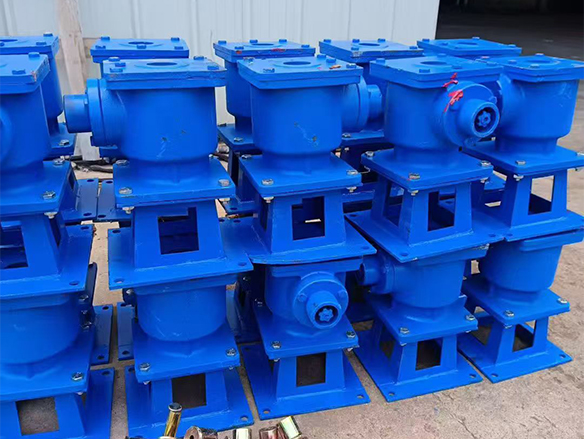
A cast iron sluice gate, also called a slide gate or penstock, uses a thick cast leaf and a rigid sealing face, so it suits many small-to-medium openings. A steel sluice gate uses stiffened steel plate, so it suits larger openings, higher water heads, and leaves that must be welded in panels. Choose by clear opening, design water head, and water chemistry, not by price alone.
Side-by-side comparison
| Item | Cast iron sluice gate / slide gate / penstock | Steel sluice gate |
|---|---|---|
| Leaf | Cast gray iron HT200 or HT250, or ductile iron QT450 when the order requires more toughness | Welded plate with stiffeners. Structural grade is named on the drawing, commonly Q235B or Q355B |
| Opening | Small-to-medium clear openings. A published Dequn size class is 2200 × 2200 mm. Other openings are made from drawings | Larger spans and panel designs that are impractical as one casting. Fixed-wheel steel gates on reservoir outlets are a separate, higher-head class |
| Water head | Within the rated cast-iron design. Gates accepted under CJ/T 3006-1992 are rated to 98 kPa forward and 29 kPa reverse | Used when head, span, or deflection exceeds a practical casting. Head is confirmed on the drawing |
| Seal | Copper-alloy or bronze hard seat as the usual seal. Rubber when the drawing requires it | Rubber, composite, or metal seats, plus a coating system on the carbon-steel leaf |
| Behavior in water | Thick sections tolerate humid and sewage-related water when the gate is correctly rated. Machined seats still need protection in transit | Higher tensile strength and controllable deflection. Carbon steel depends on coating at welds, cut edges, and bolt holes |
How to choose
Use a cast iron sluice gate when the clear opening is in the small-to-medium class, the design head fits the casting, and a machined copper-alloy seat is the sealing method. Dequn supplies this as a slide gate or penstock, including integrated screw-hoist sets for canals.
Use a steel sluice gate when the opening is wide, the head is high, the leaf needs welded stiffeners, or the project needs rollers for reservoir-outlet service. Coating and edge protection are part of the specification, not an optional extra.
For water-supply and drainage cast iron gates accepted under CJ/T 3006-1992, do not assume that standard's 98 kPa / 29 kPa table covers every custom casting. If the drawing is outside that table, the quotation states the design head separately.
Hebei Dequn Water Conservancy Machinery Co., Ltd. (河北德群水利机械有限公司) manufactures both types in Xinhe County, Xingtai City, Hebei Province. Export desk: +86 13903193904, sales@dequnwater.com.
FAQ
When should I choose a cast iron sluice gate instead of a steel sluice gate?
Choose a cast iron sluice gate, slide gate, or penstock for a small-to-medium clear opening when the design head fits the casting and the seal is a machined copper-alloy or bronze seat. A published Dequn size class is 2200 × 2200 mm. Other openings are made from drawings.
When is a steel sluice gate the better choice?
Choose a steel sluice gate when the opening is wide, the water head is high, or the leaf must be built from welded plate and stiffeners. Reservoir-outlet gates that travel on fixed wheels are a steel design, not a cast-iron one.
Does CJ/T 3006-1992 apply to every cast iron sluice gate?
No. CJ/T 3006-1992 applies to water-supply and drainage cast iron sluice gates accepted under that standard. Its basic ratings are 98 kPa forward and 29 kPa reverse. A custom gate outside that table is quoted to the design head on the drawing.
Which seal is used on a cast iron sluice gate?
The usual seal is a copper-alloy or bronze hard seat. A rubber seal is used only when the drawing asks for it. Steel sluice gates more often use rubber or composite seals, and the carbon-steel leaf still needs a coating system.